
OUR MĀUI DOLPHIN PROJECT

Māui Dolphins swimming in a pod. Photo from The New Zealand Whale and Dolphin Trust.


We are excited to present a limited edition of t-shirts to raise money for research and conservation by New Zealand’s own Whale & Dolphin Trust.
Māui dolphin (or popoto) are a subspecies of the Hector's dolphin, New Zealand's only endemic cetacean species. Māui dolphins are only found off the west coast of New Zealand's North Island, and are now one of the rarest and smallest dolphin subspecies globally.
Māui have a ‘critically endangered’ conservation status, with population estimates ranging from 60 to under 50. The estimate of 57 used on the back of the t-shirts refers to an open population model (one that takes into account births and deaths), however recently some estimates suggest the population has dipped below 50.
Currently the Whale & Dolphin Trust are fundraising for a new outboard motor for one of our three small boats, used to help monitor and protect Māui and other marine life. They currently need about $15,000, and every little bit helps. All the profit from our Māui tees goes towards these efforts for research and conservation. You can also find out more on their website.
We have a Sunday Projects journal article if you would like to understand in more detail why the protection of Māui is so important.
Now, about the t-shirts! These are made from 100% organic cotton, which is extremely soft and smooth to wear (and means no harmful pesticides are used in the making of the garment). They have been printed here in New Zealand using graphics from a talented Wellington-based designer (Billie McGuinness).
The shape is unisex, comfortable (of course), and durable. These have a medium fit, with features including:
100% ethically made and fair trade organic cotton.
Set-in sleeve.
1x1 rib at neck collar.
Sleeve hem and bottom hem with wide double needle topstitch.
Three limited edition colours available (see the white and the blush in our shop).
To keep your t-shirt looking fly, you should follow the garment instructions on the care label. We recommend you wash the garment with similar colours, do not the print, and wash or iron inside-out.
If you have any questions, enquiries, or would like another size, please contact us.
When it comes to creatures close to our hearts, dolphins have to be pretty close to the top. No other species has such a strong reputation for intelligence, socialism, playfulness and gentleness. Humans have loved dolphins since the ancient Greek times, when they were called "hieros ichthys," translated as “sacred fish." Dolphins were believed to be especially friendly to mankind, and killing a dolphin was considered sacrilegious.
Scientists have found that dolphins have some of the most sophisticated methods of communication with one another, a "highly developed spoken language" much like that of humans, using a combination of pulses, clicks, and whistles. One 2016 study, published in Physics and Mathematics, describes how dolphin’s language "exhibits all the design features present in the human spoken language, [which] indicates a high level of intelligence and consciousness in dolphins… [T]heir language can be ostensibly considered a highly developed spoken language."
Why do we care so much about the Māui dolphins in particular?
Māui dolphin (or popoto) are a subspecies of the Hector's dolphin, New Zealand's only endemic cetacean species. Māui dolphins are one of the rarest and smallest dolphin subspecies globally. Māui dolphins are listed on the IUCN Red List as Critically Endangered, and by the Department of Conservation in the New Zealand Threat Classification System as "Nationally Critical", on the basis of very low population size. Entanglement in fishing nets is the number one threat and fishing has caused major population declines. Until August 2021, the official population estimate was 57 Maui dolphins. However, the latest population survey shows that there are now fewer than 50 Maui dolphins in the World.

We are excited to present a limited edition of t-shirts to raise money for research and conservation by New Zealand’s own Whale & Dolphin Trust.
Māui dolphin (or popoto) are a subspecies of the Hector's dolphin, New Zealand's only endemic cetacean species. Māui dolphins are only found off the west coast of New Zealand's North Island, and are now one of the rarest and smallest dolphin subspecies globally.
Māui have a ‘critically endangered’ conservation status, with population estimates ranging from 60 to under 50. The estimate of 57 used on the back of the t-shirts refers to an open population model (one that takes into account births and deaths), however recently some estimates suggest the population has dipped below 50.
Currently the Whale & Dolphin Trust are fundraising for a new outboard motor for one of our three small boats, used to help monitor and protect Māui and other marine life. They currently need about $15,000, and every little bit helps. All the profit from our Māui tees goes towards these efforts for research and conservation. You can also find out more on their website.
We have a journal article if you would like to understand in more detail why Māui and why their protection is important.
Now, about the t-shirts! These are made from 100% organic cotton, which is extremely soft and smooth to wear (and means no harmful pesticides are used in the making of the garment). They have been printed here in New Zealand using graphics from a talented Wellington-based designer (Billie McGuinness).
The shape is unisex, comfortable (of course), and durable. These have a medium fit, with features including:
Set-in sleeve
1x1 rib at neck collar
Sleeve hem and bottom hem with wide double needle topstitch
Three limited edition colours available (see the baby blue and the white in our shop)
To keep your t-shirt looking fly, you should follow the garment instructions on the care label. We recommend you wash the garment with similar colours, do not the print, and wash or iron inside-out.
If you have any questions, enquiries, or would like another size, please contact us.
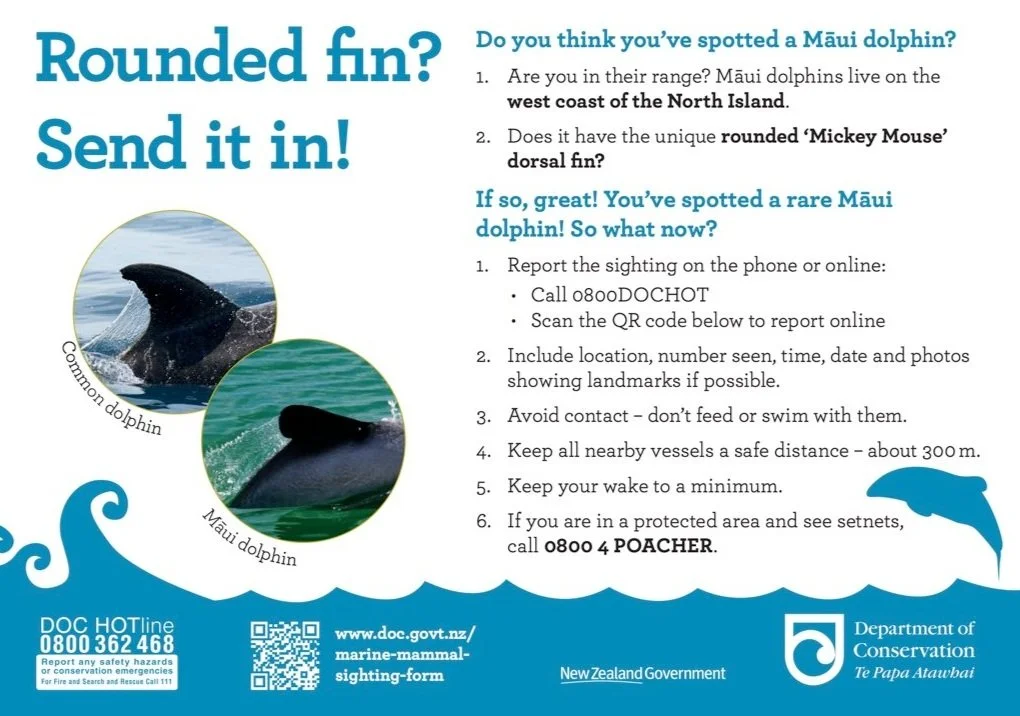
Māui dolphins are only found off the North Island of New Zealand. They are generally found close to shore in groups or pods of several dolphins, and are generally seen in water shallower than 100 metres (328 ft), though occasionally range further offshore. The current range of the Māui extends from North Cape to at least East Cape (around the long way), with occasional sightings right around the North Island.
Māui dolphins have been observed playing (e.g. with seaweed), chasing other dolphins, blowing bubbles, and play fighting. Māui dolphins use echolocation to navigate, communicate, and find their food. High-frequency ultrasonic clicks reflect back to the dolphin off any objects found in the water. Hector’s and Māui dolphins are unique among dolphins in not using whistles. Other dolphins are thought to communicate through whistles rather than clicks.

We are excited to present a limited edition of hoodies to raise money for research and conservation by New Zealand’s own Whale & Dolphin Trust. This is part of our Maui Dolphin Project that Sunday Projects has started alongside the McGuinness Institute and New Zealand Whale & Dolphin Trust.
Māui dolphin (or popoto) are a subspecies of the Hector's dolphin, New Zealand's only endemic cetacean species. Māui dolphins are only found off the west coast of New Zealand's North Island, and are now one of the rarest and smallest dolphin subspecies globally.
Māui have a ‘critically endangered’ conservation status, with population estimates ranging from 60 to under 50 and recently some estimates suggest the population has dipped below 50.
Currently the Whale & Dolphin Trust are fundraising for a new outboard motor for one of our three small boats, used to help monitor and protect Māui and other marine life. They currently need about $15,000, and every little bit helps. All the profit from our Māui hoodies goes towards these efforts for research and conservation.
We have a journal article if you would like to understand in more detail why Māui and why their protection is important. You can also find out more on their website.
Now, about the hoodies! These are ethically made from 85% organic ring-spun combed cotton and 15% recycled polyester, which is extremely soft and smooth to wear (and means no harmful pesticides are used in the making of the garment). They are limited edition and have been printed locally in New Zealand using graphics from a talented Wellington-based designer (Billie McGuinness).
The hoodie shape is unisex, comfortable (of course), and durable. These have a medium fit (f you are between sizes it is recommended to size up), with features including:
Set-in sleeve.
Double layered hood in self fabric.
Round drawcords in matching body colour with metal tipping.
Metal eyelets.
Inside herringbone back neck tape.
Self fabric half moon at back neck.
Single needle topstitch at neckline and along hood opening.
1×1 rib at sleeve hem and bottom hem.
Armhole, sleeve hem and bottom hem with twin needle topstitch.
Kangaroo pocket at front.
Each hoodie comes with a postcard and a poster on the dolphins of Aotearoa (as pictured).
To keep your hoodie looking fly, you should follow the garment instructions on the care label. We recommend you wash the garment with similar colours, do not iron the print, and wash or iron inside-out.
If you have any questions, enquiries, or would like another size, please contact us.
Based on 2012 population estimates, the International Whaling Commission (IWC) recommended full protection of Māui dolphins from Maunganui Bluff to Whanganui, banning gillnets and trawl fisheries from the shore to 20 nautical miles offshore and inside harbours. The New Zealand government initially argued that this area exceeded the range of Māui dolphins, but in 2020 extended protection over a larger area than recommended by the IWC, from North Cape to Wellington. Unfortunately, protection still only extends a short distance offshore, and a short distance into the harbours (see map to the right). Some groups in the fishing industry are against increased bans on set nets into waters further offshore and inside harbours, and say other factors are responsible for low population size, including disease, pollution, mining, and natural predation. The IUCN recommended the most comprehensive protection, banning gillnets and trawling throughout Hector’s and Māui dolphin habitat, in all waters less than 100 metres deep. So far, the New Zealand government has ignored these recommendations from international experts.
Māui dolphins currently occupy the warmest part of the Hector's dolphin species' range and, so, may be particularly susceptible to the effects of oceanic warming and acidification.
What does this all have to do with clothes and Sunday Projects?
Currently the New Zealand Whale & Dolphin Trust are fundraising for a new outboard motor for one of our three small boats, used to help monitor and protect Māui and other marine life. They currently need about $15,000, and every little bit helps. All the profit from our organic cotton Māui tees and hoodies goes towards these efforts for research and conservation. You can have a look at our collaborations in our shop, and can read more about the Whale & Dolphin Trust on the trust website.
We have also joined forces with the passionate team at the McGuinness Institute to develop a limited edition set of posters (printed locally in Wellington, New Zealand) to raise awareness for Māui and Hector conservation, which are also available in our shop.
As well as these collaborations, the clothes we choose to wear directly affect our marine environment, which emphasises why we need to make conscious decisions. Polyester, nylon, acrylic (and other synthetic fabrics) are made from plastic-blends and are a favourite of fast fashion houses. Synthetic blends are usually used to save money or to add other qualities to the textile (e.g. fire-resistant, soft, etc). The plastic fibres of these kinds of clothes release with wear and washing and turn into microplastics. It is a big issue as most modern clothes contain plastic, with plastic-based materials now making up about 60 percent of our clothes world-wide.

This poster is part of our Māui Dolphin Project, a collaboration with the McGuinness Institute and the New Zealand Whale & Dolphin Trust. We have a Sunday Projects journal article if you would like to understand in more detail why the protection of Māui is so important.
Māui dolphin (or popoto) are a subspecies of the Hector's dolphin, New Zealand's only endemic cetacean species. Māui dolphins are only found off the west coast of New Zealand's North Island, and are now one of the rarest and smallest dolphin subspecies globally.
Māui have a ‘critically endangered’ conservation status, with population estimates ranging from 60 to under 50, with some estimates suggest the population has dipped below 50.
Currently the Whale & Dolphin Trust are fundraising for a new outboard motor for one of our three small boats, used to help monitor and protect Māui and other marine life. They currently need about $15,000, and every little bit helps. All the profit from our Māui Dolphin Project goes towards these efforts for research and conservation. You can also find out more on their website.
In 2022, the McGuinness Institute will be combining their climate change and biodiversity work with our OneOceanNZ project, with 'Report OneOceanNZ: Developing a strategy for dolphin conservation'. To kick off this project, the Institute has created this informational poster on Dolphins of Aotearoa, an A2 poster (420 x 594 mm), printed on 100% recycled paper stock.
All profits to go to the amazing conservation work done by the NZ Whale & Dolphin Trust.
Whenever plastic-containing fabrics are washed, such as in the washing machine, the microplastics and chemicals inside these fabrics leech into our water systems. Because this process is so subtle and the microplastics are so small, they pass through our filters and start to do some serious harm without us noticing, which is building up into some severe microplastic pollution.
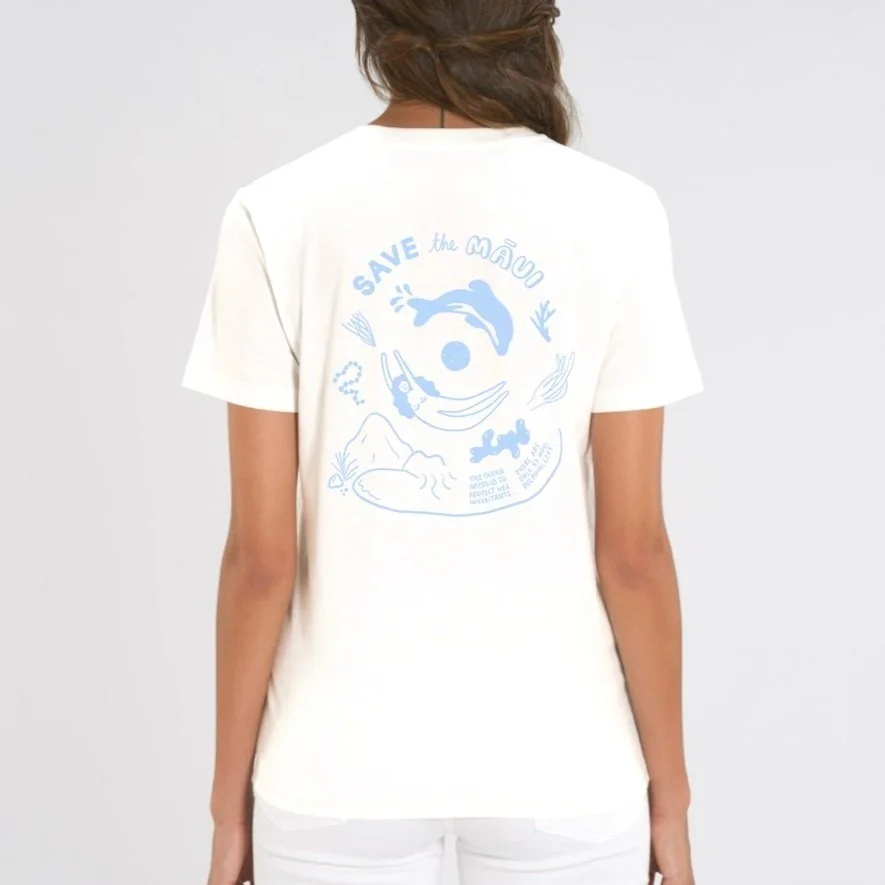
We are excited to present a limited edition of t-shirts to raise money for research and conservation by New Zealand’s own Whale & Dolphin Trust.
Māui dolphin (or popoto) are a subspecies of the Hector's dolphin, New Zealand's only endemic cetacean species. Māui dolphins are only found off the west coast of New Zealand's North Island, and are now one of the rarest and smallest dolphin subspecies globally.
Māui have a ‘critically endangered’ conservation status, with population estimates ranging from 60 to under 50. The estimate of 57 used on the back of the t-shirts refers to an open population model (one that takes into account births and deaths), however recently some estimates suggest the population has dipped below 50.
Currently the Whale & Dolphin Trust are fundraising for a new outboard motor for one of our three small boats, used to help monitor and protect Māui and other marine life. They currently need about $15,000, and every little bit helps. All the profit from our Māui tees goes towards these efforts for research and conservation. You can also find out more on their website.
We have a Sunday Projects journal article if you would like to understand in more detail why the protection of Māui is so important.
Now, about the t-shirts! These are made from 100% organic cotton, which is extremely soft and smooth to wear (and means no harmful pesticides are used in the making of the garment). They have been printed here in New Zealand using graphics from a talented Wellington-based designer (Billie McGuinness).
The shape is unisex, comfortable (of course), and durable. These have a medium fit, with features including:
100% ethically made and fair trade organic cotton.
Set-in sleeve.
1x1 rib at neck collar.
Sleeve hem and bottom hem with wide double needle topstitch.
Three limited edition colours available (see the baby blue and the blush in our shop).
To keep your t-shirt looking fly, you should follow the garment instructions on the care label. We recommend you wash the garment with similar colours, do not the print, and wash or iron inside-out.
If you have any questions, enquiries, or would like another size, please contact us.
Once these plastics arrive into our oceans, they are ingested by even the smallest of our ocean friends, as microplastics and nanoplastics fall well within the size range of the staple phytoplankton diet of many zooplankton species, such as the Pacific krill. In fact, it has been found that 56% of surface neustonic/planktonic samples from the Mediterranean Sea contain microplastic particles.
Have a look at our journal article on microplastics to understand more about the connection between the clothes we choose to wear and the state of the oceans.
Other ways to help include:
Report sightings - there is limited data on the habitat of these species. If you see a hector or Māui dolphin (lucky you!), report it to the Department of Conservation here. We need people to report sightings of Māui and Hector’s dolphin from the beach or on the water. This information helps to better understand where they live and therefore where they need protection. Sightings made by the public in the past have helped to inform where protected areas should be located.
Spread the word - share with friends and family information about New Zealand’s marine life and what we can do protect it.
Get engaged - Write a letter to the New Zealand Minister for Primary Industries with a copy to the Minister of Conservation.
Eat sustainable seafood - choose seafood you have caught yourself, using a hook and line, long-line, fishing rod, dragnet, fish trap, craypot, speargun or any other dolphin-safe fishing method.
Research - there are a number of fantastic groups working to look after these animals.
For more ideas on how to take action, look here.
If you want to learn more or support some organisations doing incredible mahi to protect Māui and the New Zealand marine ecosystem, have a look at the below resources:
The New Zealand Whale & Dolphin Trust: https://whaledolphintrust.org.nz/projects/hectors-dolphins/
A brilliant August 2021 RNZ Article summarises most recent population estimate for Māui in New Zealand.
Project Jonah is an organization working to protect the habitat of Māui dolphins in New Zealand: https://www.projectjonah.org.nz/Take+Action/MauiDolphins.html
Forest & Bird: https://www.forestandbird.org.nz/resources/action-needed-save-our-most-precious-dolphins
Department of Conservation: https://www.doc.govt.nz/nature/native-animals/marine-mammals/dolphins/maui-dolphin/
Sea Shepherd: https://www.seashepherd.org.nz/latest-news/maui-lawsuit-against-us-agencies/

Our Save the Māui organic t-shirt in blush pink. All the profits go towards the The New Zealand Whale and Dolphin Trust.